
The Future of Space Infrastructure: Dawn-Dusk Sun-Synchronous Orbit
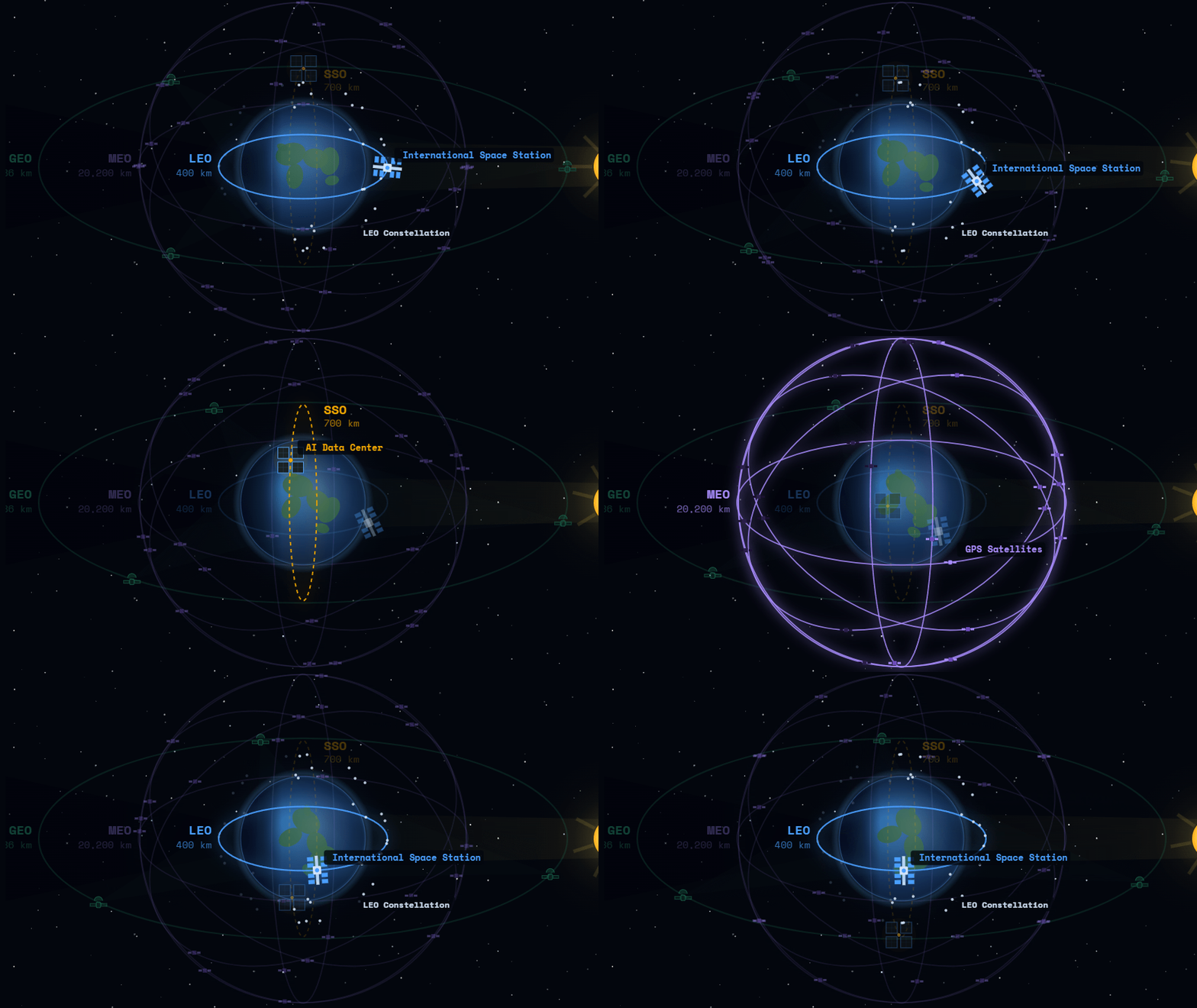
“Dawn-Dusk Sun-Synchronous Orbit is emerging as the shared optimal solution for space data centers, Earth observation constellations, orbital AI inference nodes, and in-orbit manufacturing facilities, converging independently across programs, companies, and geographies.”
What is dawn-dusk SSO?
A polar orbit (~98° inclination, 600–800 km altitude) where satellites fly permanently along Earth's terminator line, receiving 95–99% sunlight year-round under ideal conditions, with significantly reduced eclipse time compared to standard LEO. The industry calls it the "eternal daylight orbit."
Why not regular LEO?
Standard low Earth orbit puts satellites in Earth's shadow for 35–40 minutes every 90-minute pass, forcing:
Massive battery banks that double launch mass and cost
Repeated deep charge cycles that degrade batteries, with no maintenance possible in orbit
Excess heat from batteries requiring larger, heavier radiators
Why dawn-dusk SSO wins for many mission profiles:
Near-continuous solar power enables significantly lighter battery design, reducing system mass and cost
Solar panel capacity factor far exceeds what is achievable in standard LEO, with no atmospheric losses
Simplified thermal management with reduced radiator requirements
Stable power output well-matched to continuous workloads like 24/7 AI training and inference
What's coming and what's at stake:
Space data centers processing real-time remote sensing and AI workloads on-orbit
Dense Earth observation constellations enabling centimeter-level global monitoring
Early-stage in-orbit manufacturing and assembly experiments
The challenges are real:
Kessler Syndrome risk as LEO becomes increasingly congested across all orbital bands
Extreme thermal management in vacuum
Latency constraints that require rethinking network architecture from scratch
The physics of power and heat make dawn-dusk SSO a compelling answer for infrastructure missions that demand reliable, continuous energy, and the breadth of programs converging on it speaks for itself.
We see a future where orbital infrastructure becomes as foundational as cloud computing, and the race to build it is already underway.
